
Introduction
On May 22, 2025, the Wichita and Affiliated Tribes and Washoe Tribe of Nevada and California filed a lawsuit against the United States Government for using the funding that was supposed to be allocated to Native Nations for the creation and upkeep of the Federal Indian Boarding School Program.
This is the first time a trust lawsuit has been filed against the United States regarding Native education, and it comes directly on the tail of the 2022 and 2024 Federal Indian Boarding School Initiative Investigative reports. [1]
These reports revealed the horrors and the depravity of these programs in great detail. The 2022 report quotes congress acknowledging the insidious nature of their stance towards native education: “that from ‘the beginning, federal policy toward the Indian was based on the desire to dispossess him of his land. Education policy was a function of our land policy.’”
A Grave Injustice
The reports outline the early policies of the US Government towards Native education, pointing out that forced assimilation was a deliberate military strategy enacted with the goal of erasing native cultures. Assimilation was the favored system for this erasure not because it was less violent, but because it was deemed cheaper than war. Federal records contain a large amount of evidence “that the United States coerced, induced, or compelled Indian children to enter the Federal Indian boarding school system.” It is abundantly clear that early American policy towards the native peoples involved control by any means necessary. [2]
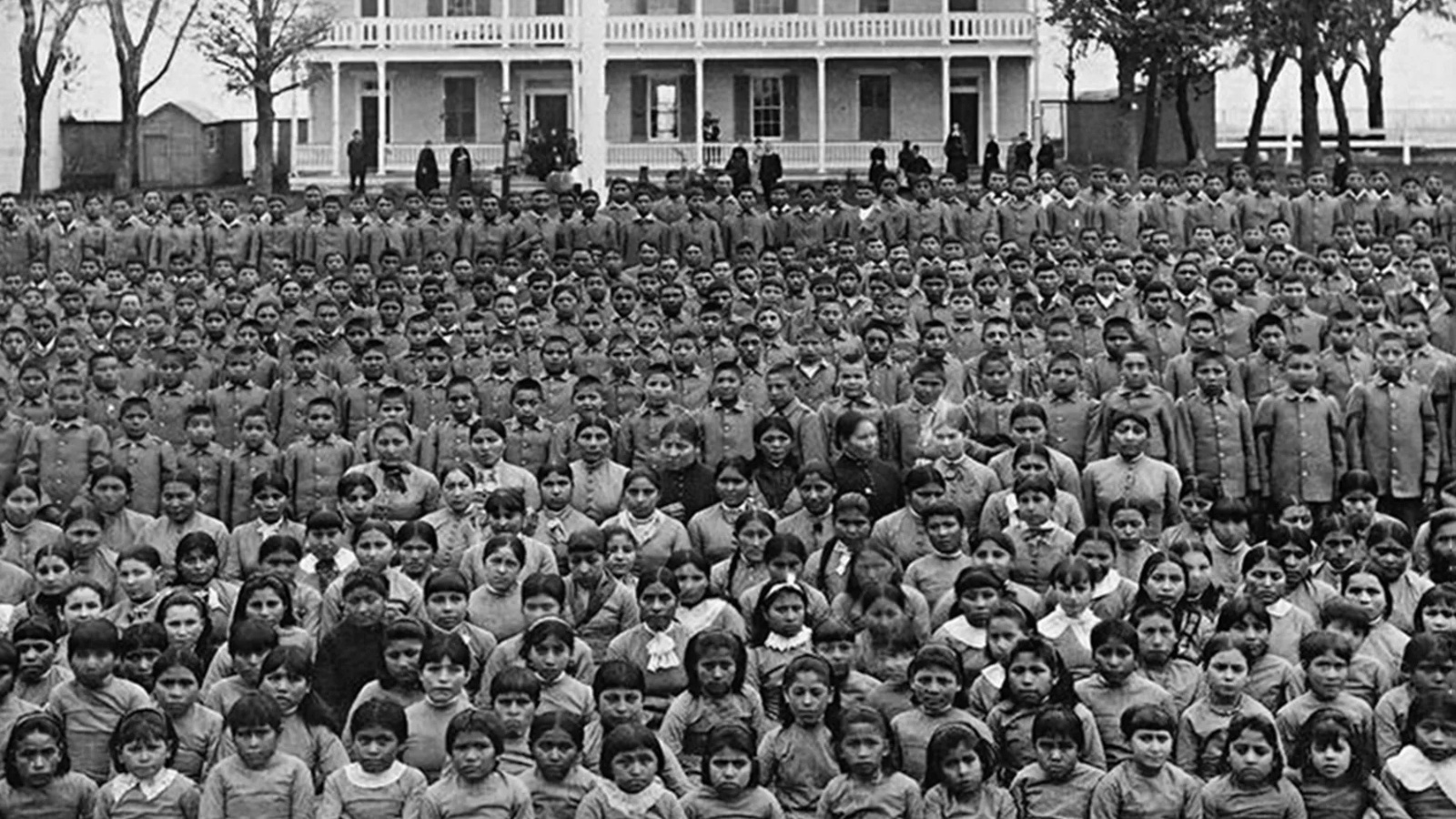
One such function of assimilation has direct ties to Cumberland County; the Carlisle Indian Industrial School. The boarding school was founded by Richard Henry Pratt, an army captain who had spent his time in the military fighting against Comanche, Cheyenne, Arapaho and Kiowa people. Debuting with Pratt’s genocidal phrase “kill the Indian, save the man”, the school opened as the first off- reservation boarding school in 1879. [3] This was a new deployment of strategy in cultural genocide, and records show it was deliberate.
The 2022 report states
[that] federal records indicate that the United States viewed official disruption to the Indian family unit as part of Federal Indian policy to assimilate Indian children… ‘[O]n the whole government practices may be said to have operated against the development of wholesome [Indian] family life. Chief of these is the long continued policy of educating the [Indian] children in boarding schools far from their homes, taking them from their parents when small and keeping them away until parents and children become strangers to each other. The theory was once held that the problem of the [Indian] could be solved by educating the children, not to return to the reservation, but to be absorbed one by one into the white population.’
Native boarding schools were funded through a variety of means, including using Indian treaties to appropriate funds under educational provisions and proceeds from cessions of native land through treaties, many of which were signed under duress and coercion. [4]
Not only were they funded by expropriating tribal resources, they were run in a rigid, highly structured and militant way that allowed its students virtually no choice in their life at school. Native children were stripped of their Native names, renamed, had their hair cut, were forced to wear standard uniforms, and were forbidden from speaking their native language, engaging in their native culture, or exercising non-christian religious views and practices. [5]
In addition to the systemic policies of oppression native people were forced through, conditions and treatment of students at boarding schools such as the Carlisle Indian industrial school were notably poor and abusive. Conditions were so severe mass child graves have recently been uncovered at a number of cites. Punishments such as solitary confinement, withholding food, whipping, flogging are all documented means of control over students.
It was not uncommon, and was deemed the “most satisfactory method” of punishment for the school to force older students to administer punishment on the younger students. The 2022 report points out the poor conditions, stating “Rampant physical, sexual, and emotional abuse; disease; malnourishment; overcrowding; and lack of health care in Indian boarding schools are well-documented.” Malnourishment was very common among students, sugars and starches were the primary source of nutrients, with little fruit and vegetables to supplement their diet. Water quality at the boarding schools was documented as being poor, further worsening health conditions. [6]
“The labor of [Indian] children as carried on in Indian boarding schools would, it is believed, constitute a violation of child labor laws in most states” -Merriam Report, 1928. The “vocational” training the government mandated of the students was more similar to the labor of a labor camp. At many of these institutions the day was split into two parts: half of the day was “academic” and the other half of the day was labor to continue general functions of the school.
There was not enough funding provided from Congress for general upkeep, so this burden fell on the students. These roles included but were not limited to washing, ironing, baking, cooking, sewing, farming, gardening, grounds and building maintenance, and more. [7]
Since the policy of the United States government was to break the bonds of Indigenous children to their parents, many children were taken from the reservation and sent to these boarding schools at increasingly younger ages, and expected to take part in these abusive labor systems, forced to upkeep the genocide of their own culture at an incredibly young age.
A documented observation of this is provided in the 2022 report which states:
[O]ne hundred of the 191 girls are 11 years of age or under. The result is that the institutional work, instead of being done wholly by able-bodied youths of 15 to 20 normally enrolled in the early grades, has to be done, in part at least, by very small children-children, moreover, who, according to competent medical opinion, are malnourished. [8]
Recommendations for Justice
Volume II of the Boarding School Initiative Investigative Reports outlines meaningful actions that are recommended of the United States government. These actions are listed below, and expanded upon within the report.
- Acknowledge, Apologize, Repudiate, and Affirm
- Invest in Remedies to the Present-Day Impacts of the Federal Indian Boarding School System
- Individual and Community Healing
- Family Preservation and Reunification
- Violence Prevention
- Redress Indian Education
- Revitalization of First American Languages
- Build a National Memorial
- Identify and Repatriate Children who Never Returned from Federal Indian Boarding Schools
- Return Former Federal Indian Boarding School Sites
- Tell the Story of Federal Indian Boarding Schools
- Invest in Further Research
- Advance International Relationships4
Some progress has been made since the publishing of these reports. The Carlisle boarding school was made a dedicated national monument in December, following Joe Biden’s formal apology in October. This change will allow public access to the site, which was previously within the confines of the US Army War College in Carlisle, with hopes of further providing education to the community regarding this dark part of our history. [8]
In April, the Trump Administration cut $1.6 million in funding for the continued research and digitization of records from the federal boarding school program nationwide. This continued research is being done with the hopes of providing healing and education, but also to reconnect families with one another through documents that were not previously public, and losing such a large amount of federal funding will make this process much more difficult. [9]
The remnants of the violence of early American colonialism will continue to linger as long as a culture of American Imperialism remains embedded in our systems of government. Donald Trump continues this legacy of violence as his administration of billionaires once again cast aside history for the sake of their own agenda.
Conclusion
It is important that residents of Central Pennsylvania acknowledge that our area has direct ties to a brutal history of cultural genocide so we may become advocates for the necessity of further research and healing.
The lawsuit filed by Wichita and Affiliated Tribes and Washoe Tribe of Nevada and California is an example of how we can continue to fight these battles for short term solutions while also looking to organize to build a socialist future; one that will not struggle to acknowledge and right the wrongs of capitalism and imperialism.
References
[1] https://dicellolevitt.com/wichita-and-affiliated-tribes-washoe-file-landmark-lawsuit-against-u-s-government-over-indian-boarding-school-program/
[2] https://www.bia.gov/sites/default/files/dup/inline-files/bsi_investigative_report_may_2022_508.pdf
[3] Ibid.
[4] Ibid.
[5] Ibid.
[6]https://www.npca.org/parks/carlisle-federal-indian-boarding-school-national-monument
[7]https://www.bia.gov/sites/default/files/media_document/doi_federal_indian_boarding_school_initiative_investigative_report_vii_final_508_compliant.pdf
[8]https://www.doi.gov/pressreleases/secretary-haaland-applauds-president-bidens-establishment-carlisle-federal-indian
[9]https://apnews.com/article/boarding-school-native-americans-research-grants-6309640a3df5934e46bc1151e78c99f8