
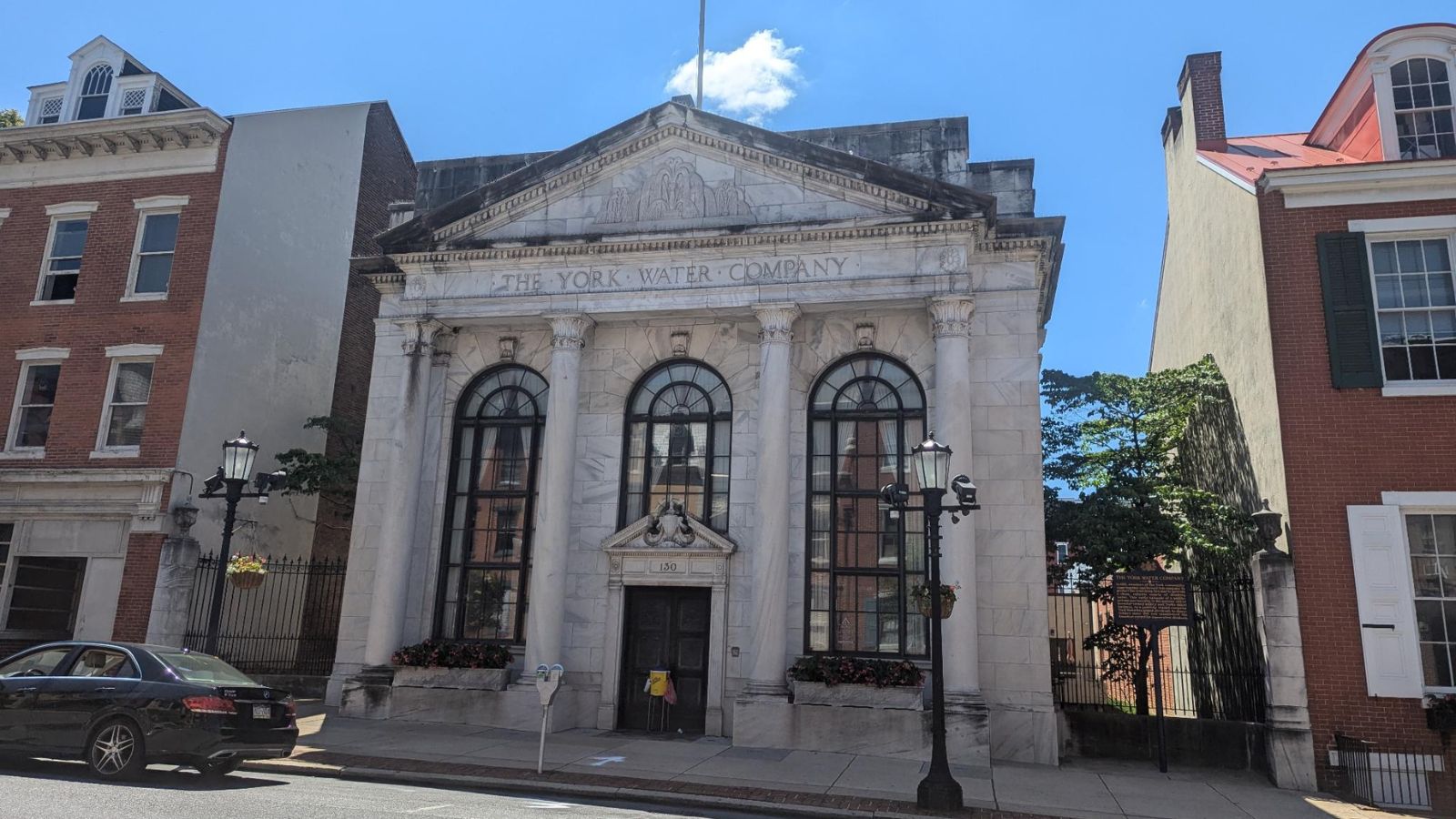
(Pictured, York Water Company located on West Market Street, York PA)
Introduction
Within the United States 90% of water infrastructure is managed by municipalities. Most water services, in other words, are state owned. Even though only 10% of water resources are privatized, it is a growing number.1
As we will see in the example of York, PA, with a population of 45,000, any amount of privatization is an infringement on the basic human right to water and therefore unacceptable. Reflecting the growing national trend toward privatization, the rate of water privatization in Pennsylvania is more than double the national average at 26%.2
Privatized Water in York
Of the 150 water systems overseen by the Pennsylvania Utility Commission, the York Water Company is the focus of this article. In 2024 York Water had an operating revenue of nearly 75 million and a net income or profit of 20.3 million. The profit received by shareholders, or dividend payout, was 60.8%.3
The companies who invest and profit from York Water Company, together, own 30% of the company: BlackRock with 10.5%; Vanguard at 5.91%; Zimmer Partners with 5.1%; and State Street at 3.3%.4
Maximizing shareholder profit and lucrative compensation of executive staff serves to protect the extraction of water resources as profit. In other words, privatizing water thereby turning it into a commodity, increases its cost limiting people’s access to this vital resource and human right.
It is not surprising that York Water Company has been granted permission by the Pennsylvania Utility Commission (PUC) to increase its rates. In 2023 York Water Company increased its rates 19.5% for residents and 29% for businesses and its wastewater customers seeing a 45% rate hike.5
The privatized wastewater treatment facility in York owned by Pennsylvania Water, a subsidiary of American Water (the largest regulated water and wastewater company in the United States), sought to increase its rates by 20% but had its hike slashed by the PUC to just 9.9%, with an ordering of American Water to direct more funds into financial assistance programs that could come from shareholders. York city residents will have their bills increase an average of 36 dollars a month.6
Fighting Back Against Privatization
All hope is not lost though. Through organizing residents can fight back and stop the privatization process. There are many examples of successful anti-privatization campaigns.
For example, in Stockton, California between 2003 and 2007, after a corporate takeover of water services that lead to dramatic rate hikes and issues with service, community members organized a coalition, Concerned Citizens Coalition of Stockton, to centralize their fight back.
The coalition organized town hall meetings, protests, door-knocking canvassing, and outreach. The focus was on a public vote to re-municipalize the city’s water system. All their hard work paid off and the vote passed in their favor.
Some organizers have successfully used lawsuits to block water privatization. For example, between 2005 and 2008 in Felton, California, residents sued California American Water and eventually bought back the water system through a public buyout.
Closer to home, in 2018, organizers in Baltimore, Maryland successfully got the first permanent ban on water privatization passed in any U.S. city. This was done through a city charter amendment.
Conclusion
The fact that our local governments not only allow but facilitate the privatization process speaks to the class character of the state apparatus. While campaigns can block capitalism’s drive to privatize and profit from every basic need necessary for survival, only through the socialist reorganization of society can our rights be secured once and for all time.
Socialism in the United States is possible in our lifetime if we organize and fight for it. Basic resources like water needed to meet human needs can be protected from privatization and capitalist-class profiteering. This and much more is immediately possible, but only if we unite together through organization. When we organize, we can win.
References
1. Food and Water Watch. “Water Privatization: Facts and Figures.” Food and Water Watch, 12 Aug. 2015
2. Parish, Marley. “Water Privatization Is on the Rise in PA. Here’s What You Need to Know.” PennLive, 25 July. 2024.
3. Market Screener. “York Water Financial and Governance” Market Screener, 6 Feb. 2020.
4. “York Water ShareOwnership.” Market Screener, 6 Feb. 2020.
5. “PUC Approves Settlement for York Water Hike.” PA Public Utility Commission, 12 Jan. 2023
6. Argento, Mike . “PUC Slashes American Water Rate Hike Request;Rates in York County Frozen for Time Being.” PennLive, 12 Jul. 2024